The Hunger of Memory
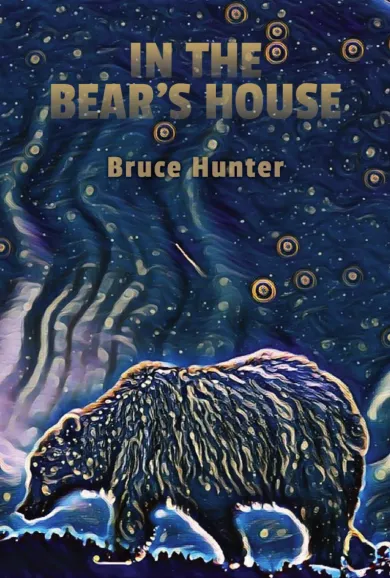
In the Bear’s House, Bruce Hunter. Frontenac House, 2025 (originally published 2009).
I remember when I bought a ticket to see the cave drawings of my Magdalenian ancestors in the Grotte de Niaux, nested in the French Pyrenees. The Sites Touristiques Ariège had my money. I assumed that was enough. It wasn’t. To gain full entrance I was instructed to leave behind all the familiar tools I used for guidance and memory. They locked away my pen, pencil, paper, phone, camera, notebook, flashlight, and snack. I would follow the guide with nothing more than my body and some loosely formed notion of hope for a life-altering experience. I was not disappointed. I had one. Such was my experience of reading Bruce Hunter’s In the Bear’s House.
I entered In the Bear’s House with some hope I might learn something of the deaf experience. I knew to expect the story of a young mother, Claire Dunlop raising her deaf son, Trout in the 1960s in Calgary and the Rocky Mountain grasslands of the Kootenay Plains where there was little support available for either of them. Although Hunter uses alphabets, words, paper, and the world of literary intention, I am stripped of everything I typically depend on to read a book.
Hunter’s use of language tells more than the story of a deaf boy. His sentences become my simulacrum of beauty, surprise, and sorrowful experience in a muffled, confusing world. “His mother told him he was special. But like the Special class at the school downtown. That special meant Dense or Thick, Odd or Different. As in Slow. The stones of adults were wrapped in cloth.” So, while I did learn more about what it’s like to be deaf, Hunter communicated with a sonic boom to my emotional body. I left the cave of this book tender and more humane.
Hunter’s poetic prose delivers me into an infinitude where my senses do not serve me. I am dropped into this author’s relationship to a world I could not know because I’m not deaf. Hunter is. Neither was I raised by a teenage mother who bore and parented a son for two years while her young husband, Lowell, completed his prison sentence of two years hard labour. I didn’t grow up in Calgary, and I know nothing about the wilderness. But I was a child in the early days when colonial Canada was pressing the first creases of modernity into a land whose name came from the Iroquoian word kanata, for village, or collection of huts. I grew up aware my country was kind, but as I came to understand, our origami peace crane has much to be sorry for.
That said, Hunter tells the story of Canada’s formative years without adding to my guilt. Rather, In the Bear’s House becomes a helpful companion to the sorrow I carry in my adulthood. The book is not intentionally or explicitly political, nor is it not. Governmental affairs punctuate and puncture our lives in offhanded and casual ways. World leaders cloistered behind doors with egos and agendas must remember they make life harder than it already is because they want to keep their jobs. Hunter’s Stoney Nakoda characters are no longer historical references. They become alive in his pages. At the same time, sympathetic weeping for their loss of land, language and lives are not useful, unless I recognize present day conditions demand empathy, so the same mistakes are not made.
In Hunter’s prose I fear for things I didn’t know I could, but the need to prove myself, to myself, is familiar:
Cold tears and fear blinded Trout. The sled handles pounded his hands through deerskin mitts. Circles of sweat formed under his arms as he jockeyed the sled side to side, but the rubber soles of his felt-pacs kept him on the runners.
I typically find books with multiple points of views and different narrators difficult to read. Too often there’s one error that blows the whole smoke and mirrors apart. This, however, is not the case here. Chapters alternate back and forth between the first-person view of the mother, Clare, and a limited-omniscient narrator telling the story of Trout’s inner and outer world. Rather than frustration, I experience a fascinating and compelling sensory refraction. Light bends between mediums of differing density. In this case the direction of the light is altered at the boundary between Clare and Trout. Their optical densities are not the same, separated as they are into mother and child, female and male, hearing and deaf. Their story looks like a bent straw in the glass; the same story told along the energetic spine of a mother and son. I’m not confused or lost or distracted by mistakes because Hunter’s poetic sense travels into the heart of human experience over and over again. “Trout wasn’t sure. Her eyes didn’t agree with her words.” The characters in In the Bear’s House become guides to the centre of my metaphorical Pyrenees. I can hear the ancient people who served their belief in life in this dark. Hunter has shown me that a good life does not depend on five perfect senses, but it does depend on love.
The book doesn’t deliver a happy ending. I would not care about writing this review if it did. The narrative arc moves like a sound wave. There isn’t just one obstacle. Life is the problem, but it isn’t something to overcome, because life isn’t something Hunter can solve. Instead, the author offers an unequivocal point of view layered from deep within himself. In the Bear’s House is a companion to the crooked love, bent and forged on the animal survival of my parents and grandparents in a Canada into which I was born.
The book is page-turning, but you won’t read it fast if you want to read it completely. The words breathe in a rhythm that sustains and awakens. I hear the beast wake up and lumber from the cave. But I’m not afraid. The bear is not my enemy. I recognize the creature as the guide. I’m not going to be the snack.
— S. Portico Bowman’s Would You Give Up Arms for Wings? A Story Inspired by the Visionary Life and Writings of Paulus Berensohn (forthcoming) was a finalist for the 2024 AWP Sue William Silverman Prize for Creative Nonfiction and received generous support from the Canada Council for the Arts.
Read this review and many others in Issue 309 (Autumn 2026). Order the issue now:
Order Issue 309 (Autumn 2026) Canadian Addresses
Order Issue 309 (Autumn 2026) International Addresses