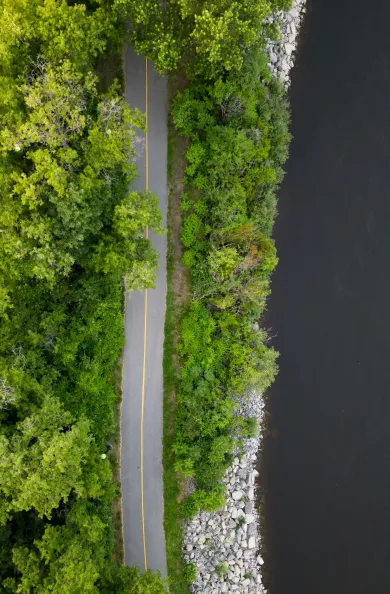
I live in a river valley. It has taken millennia for the long path of the Gatineau River to etch this valley out of the rocks and hills of the Canadian Shield. Vast, countless forests, fields, and wetlands border the river’s shoreline, bringing their boundless biodiversity.
The Gatineau River’s headwaters emerge from a chain of lakes about 400 kilometres north of Ottawa.1 Then, it heads south, more or less – after all, what river, creek or stream ever flows in a straight line? Finally, far downstream, an imposing cityscape looms over it, and the Gatineau River ceases to exist, feeding into the larger Ottawa River.
The Anishinàbeg people live on their ancestral, unceded lands in the valleys of the Ottawa and Gatineau rivers. Anishinàbeg people call the Gatineau River Tenakatin Zìbì. Tenakatin denotes a river that must go a long distance to get from the mountains to the forests.2 Zìbì is the Anishinàbemowin word for “river.”3 The Anishinàbeg people have also called the Gatineau River “wrinkled river” because it has so many rapids.4
My partner and I have made this Zìbì valley our home since the late 1980s, when we moved to west Quebec from Ottawa. During all the years since, we have lived in the municipality of Chelsea, which is strongly rooted in and formed by the Gatineau River’s geography and history. Chelsea is a long, narrow district, running mostly north-south, bordered on the east by the Gatineau River and on the west by the Gatineau Park. River, forests, hills, rock, and all the flora and fauna that go with them deeply impact life in Chelsea and beyond. They form stunning land- and waterscapes, and provide attention-grabbing, nature-driven backdrops to life here. It’s a life that sparks and inspires us every day.
Last year, my partner and I sold our 1930s-era converted cottage and moved several kilometres, still within Chelsea, to a small, new apartment building in the Farm Point area. It’s the northernmost part of Chelsea, set quite deeply in the Gatineau River valley. Where we now live is a stone’s throw (if you have a strong pitching arm) from the river. Nearby is a lightly forested area that is just now bursting with birdsong, spring blossoms and creature life.
We loved our little house. There, we were surrounded by towering pines and robust maples. Now and then, visiting deer birthed and raised their offspring in our back yard. We couldn’t see the river from the house, but it was only a five-minute walk away. Moving was emotional. But along with no longer having to tend to a house and a patch of land, being in Farm Point has changed our perspective. We feel blessed to be much closer to the river, held deeply within its valley.
Every morning, when we head out to take our dog for his walk, seeing the river is like receiving an unasked-for, one-of-a-kind gift. Surprise and beauty are the only predictable possibilities of what’s to come. Sometimes, we hold our breath in anticipation. We are always rewarded. It may be an instant of light firing upon the water, a stuck log hosting a queue of turtles on a sun-basking day, or the shush of a kayaker’s paddle on the river’s surface. This morning, it was a Canada Goose couple. They set off onto the water, sheltering between them their three tiny goslings, who looked as if they’d be right at home bobbing in a child’s bathwater. Whatever sight or sound may capture the moment, we know it’s a gift, free for the intaking eye and fuel for a soul working through life’s changes and challenges.
Yes. There’s so much here. That’s the bounty of living close to a river. When you stop, look at and listen to the river, long enough and often enough, you open yourself to it as a blessing, a miracle, a wonder. It’s like seeing an old, old friend, just a little differently, yet the same.
And yet never the same.
1 Canadian Geographic Information website, 11. Tenagàdino Zìbi - Gatineau River Information Card, found at https://cangeoeducation.ca/wp-content/uploads/2024/07/11.Tenagadino-Zibi-Gatineau-River-Information-Card_EN.pdf/ (accessed May 25, 2026).
2 Fondation Rivières website, “Adoptez une rivière,” found at https://fondationrivieres.org/en/projects/adoptez-une-riviere-gatineau/ (accessed May 23, 2026).
3 Rick Henderson, “’Gatineau’ – Paddling Through the History of a River’s Name,” Up the Gatineau!, Volume 46 (2020): Gatineau Valley Historical Society website, found at https://www.gvhs.ca/publications/utga-gatineau.html (accessed May 23, 2026).
4 Ibid.
— Mary Trafford resides on the unceded territory of the Anishinaabe Algonquin Nation (Chelsea, Québec). Her writing has appeared in Blue Heron Review, Canadian Woman Studies, CV2, Gone Dogs, The Fiddlehead, The Townships Sun and other publications. She won Arc Poetry Magazine’s inaugural Diana Brebner Prize.
You can read Kath Healing's poem "Hope springs" in Issue 308 (Summer 2026) Disability: The Revolution. Order the issue now:
Order Issue 308 (Summer 2026) Disability: The Revolution (Canadian Addresses)
Order Issue 308 (Summer 2026) Disability: The Revolution (International Addresses)