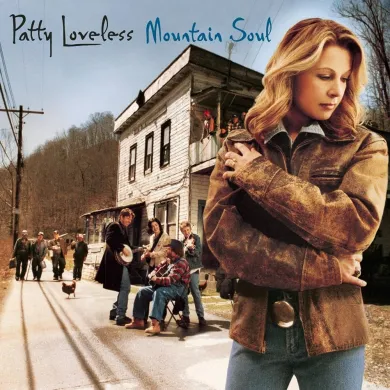
Patty Loveless has provided the soundtrack of my life. My highs and lows, my triumphs and heartache (I’ve been there before), my country roots, and my big dreams have all been reflected in her songs. How lucky I’ve been to listen along! And yet, until recently, I’d not paid as much attention to a key part of her oeuvre.
With the rise of country pop, Patty found her country radio career coming to an end as the 21st Century began. Many of her peers – names like Faith, Garth, Trisha, and Shania - turned the pop up a notch.
Patty didn’t. Instead, she went back to the deep, dark hills of Eastern Kentucky and created one of the great country albums, Mountain Soul. A few months back, I finally decided to give it a deep listen. And my God, why had I waited so long?
Patty is famously not a song writer, instead using whatever fame she had to elevate Nashville’s many struggling songwriters. For Mountain Soul, Patty and her second husband, her longtime producer Emory Gordy, Jr., recorded several new songs but also mixed in updated folk songs from the Cumberland Mountains. The result is astonishing. Country music’s purest voice never sounded so pure. Kentucky’s saddest chanteuse never sounded so sad. With Mountain Soul, Patty moved from personal trauma to generational trauma with vocal dexterity but something else, too. There’s a tangible freedom in her sound, an unburdening that turns her legendary twang into a Kentucky daughter’s lament.
As a whole, the album is a work of genius, evoking the joys and regrets of the region in equal measure. With near mystic precision, she channeled the coal-choked horrors of Appalachia’s past and the opioid-driven devastation of its future. On a song-by-song basis, it’s bullet after bullet to the belly, climaxing with the kill shots of “Soul of Constant Sorrow” and “You’ll Never Leave Harlan Alive,” before triaging the listener’s soul with “Two Coats” and “Sounds of Loneliness.”
“Soul of Constant Sorrow” is Patty’s take on the same folk song that set the world ablaze in 2000, when it was used in the Coen Brothers’ film O Brother, Where Art Thou? That version won at the Grammy’s, where the soundtrack for the film won the vaunted Album of the Year award. And yet, listeners and critics in the know have and continue to call Patty’s version the definitive one.
The song’s final song is a gentle lament and it’s the rare song that Patty wrote herself. She didn’t write it for the album, however. She wrote it in 1971, as a 14-year-old whose father was dying of the black lung, and later used it to audition for the Wilburn Brothers and later included it in her first album, 1987’s Patty Loveless.
I love it when an artist brings back a song from a former album. And not in the “greatest hits” sense. When a singer brings back a song from a prior album, it tells me that the artist feels the song deserved a wider audience, warrants a second listen, or that they’ve found a way to greatly improve it. With Patty and Mountain Soul, I think it’s a way of telling us that this album is deeply personal. Mountain Soul is the soundtrack of her life.
How lucky we are to listen along.
— Mike McClelland, like Sharon Stone and the zipper, is originally from Meadville, Pennsylvania. He teaches creative writing at Eastern Illinois University and his work has appeared in the Guardian, Rolling Stone, The New York Times, WIRED, Boston Review, Vox, and a number of literary magazines and anthologies. Find him at magicmikewrites.com.
You can read Mike McClelland's story "C.E.G." in Issue 308 (Summer 2026) Disability: The Revolution. Order the issue now:
Order Issue 308 (Summer 2026) Disability: The Revolution (Canadian Addresses)
Order Issue 308 (Summer 2026) Disability: The Revolution (International Addresses)