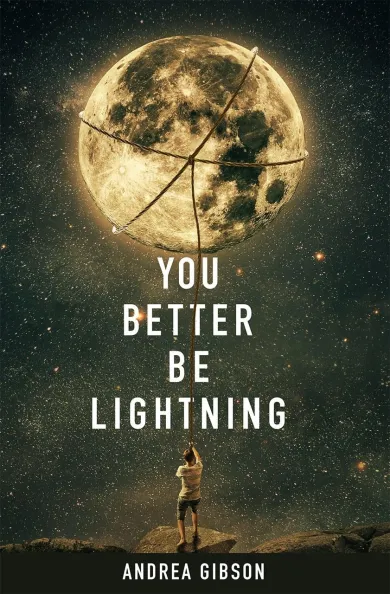
After watching the documentary Come See Me in the Good Light—a vivid love story chronicling the final years of poet Andrea Gibson’s life as they fought ovarian cancer and prepared for a last spoken-word performance––I wanted to hold her voice in my hands. So I began reading their 2021 poetry collection You Better Be Lightning. It immediately became clear why Gibson’s work resonates so deeply. Their poems move between tenderness and defiance, grief and gratitude, capturing the complexity of what it means to be human.
Gibson's website describes their work as spanning "the deeply personal to the vastness of the world," exploring everything from love to illness, to space to climate change. One poem, “Every Time I Ever Said I Want to Die "(page 29), Gibson opens with:
–– I meant I am willing to do anything to live. Even leave this world forever.
Though erupting from a place of desperation, the poem reads not as a death wish, but as a reckoning, an exploration of the body's journey through personal and collective landscapes. The poem suggests that pain itself can be a doorway to understanding:
–– If your wounds are still open, trust that they are doors to the answer, and walk through. What if we don't have to be healed to be whole?
As someone living with a chronic disability, I recognize the tension Gibson describes. Illness reshapes one's sense of self, forcing an ongoing reckoning with what remains intact, what is fractured, and how to live between those states. I often wrestle with my own sense of brokenness, in search for a middle ground, some version of normalcy. Perhaps that is why I'm drawn to stories that acknowledge that we can sit––or even sway–– between light and dark, awe and grief, without needing to resolve one or the other.
Gibson's poems are ultimately about survival, about the complicated language we use to make sense of physical or emotional pain. You Better Be Lightning does not promise healing. Instead, it offers companionship. Gibson speaks from the voice of someone who understands that living––and confronting death––requires holding contradiction in both hands.
— Mel Williams is a Toronto-based writer and disability advocate whose memoir Little Flames Under My Skin was runner-up for the 2025 Sue William Silverman Prize for Creative Nonfiction. Her work appears in The Brevity Blog, Dribble Drabble Review, Emerging Writers Reading Series, Rollick Magazine and she authors the Substack newsletter Little Flames featuring essays and interviews on illness, reinvention, and craft.
You can read Mel Williams' story "Peripheral Bodies" in Issue 308 (Summer 2026) Disability: The Revolution. Order the issue now:
Order Issue 308 (Summer 2026) Disability: The Revolution (Canadian Addresses)
Order Issue 308 (Summer 2026) Disability: The Revolution (International Addresses)