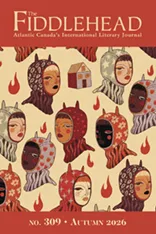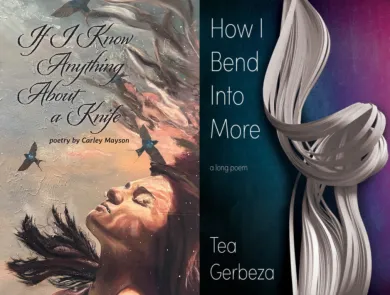
Two books of poetry in particular have deeply moved me and altered my view of myself and my place in the world as a disabled person. Both Carley Mayson’s If I Know Anything About a Knife and Tea Gerbeza’s How I Bend into More have powerfully rejected societal definitions of “better” or of “suffering”, revealing a joy all the more powerful for existing alongside the struggle to liberate our disabled bodyminds from a world that focuses only on our pain.
Carley Mayson’s If I Know Anything About a Knife speaks unflinchingly about the disorientation of anxiety, panic attacks, suicidality and addiction. Yet she balances these heavy themes on a knife’s edge, counterweighted by the dappled light of “the moments in between” - cups of tea shared with her partner, a loving dog’s jowls in her lap, family, both by birth and by choice, who travel alongside us, interwoven as the light is with the dark. When this precarious balance between hope and despair loses its equilibrium, it is those small moments of light, love and acceptance that pulls us back, again and again. Mayson resists the pull to define “better” as a point of arrival, or a state with a single definition, but rather as being able to love and be loved in all our complexity, being “thankful to feel all of this / what a gift to own all of this pain”.
Tea Gerbeza’s How I Bend into More creates “a new grammar of self”, rewriting her identity as a disabled person with scoliosis in a long poem that, “lean[s] into parentheticals” to “grasp what my body has to tell me”. Through language and paper-quilled art, the image of the curved spine “(an aside / ( remaining open” gradually unfolds into a representation of a new self. Gerbeza expresses her disabled body on the page, unfurling “the kaleidoscope of I” into a fully embodied conception of the disabled identity, apart from the empty, ableist ideas of shame and suffering which tried, and failed, to define her. Gerbeza invites us into this collective rebirth, to ask “what already has a home in / my body” and to embrace every version of ourselves that grows “in the patient space between pain.”
In recognizing the vibrant life that springs from the dappled places, or the vertebral spaces, where the punctuation of pain is voiced alongside joy, Mayson and Gerbeza’s works describe true disabled embodiment and reclaim the disabled bodymind from the ableist perceptions that have attempted to erase our light and tell of only our shadows.
— Leanne Charette (she/her) has cerebral palsy and writes poetry grounded in her experience as a disabled adoptee and mother. Her work has been published by CV2, Eavesdrop, PRISM International, Vallum Magazine, and more. She lives on the Haldimand Tract, in so-called Kitchener, ON with her husband and twin sons.
You can read Leanne Charette’s poem "Atlas Materna" in Issue 308 (Summer 2026) Disability: The Revolution. Order the issue now:
Order Issue 308 (Summer 2026) Disability: The Revolution (Canadian Addresses)
Order Issue 308 (Summer 2026) Disability: The Revolution (International Addresses)