I’ve been reading a lot of contemporary sonnets and am a bit in love with their surprising manifestations, their intricate weaves, their speed and motion.
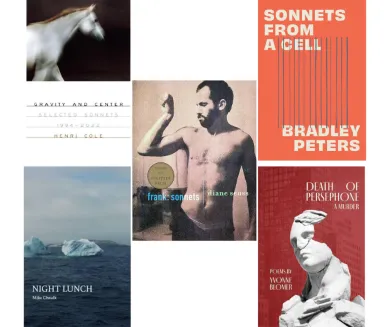
Because I’m grateful for the permission that working with form grants me, anyone working in the modern sonnet form has a reader in me. So of course I devoured Diane Seuss’s frank: sonnets when it won the Pulitzer Prize in 2022. I have never admired a Pulitzer- winning book more than this one; Seuss has a way of combining rigor with a vagabond style that encompasses just about anything that can happen in fourteen lines. “The sonnet, like poverty, teaches you what you can do / without,” Seuss notes: that line break! I followed up with Henri Cole’s stellar Gravity and Center in which Cole wrote this phrase, which I’ve been thinking about ever since: “a poem is a sonnet if it acts like one.” And reading Cole’s poems, you can see that he didn’t mean a poem was a sonnet if it followed the centuries-old rules right down to the volta and final rhyming couplet; it might follow them – or not – but the idea is that the sonnet acts, it acts upon us, and it acts despite us.
Canadian poets are getting into the act, too, and not only in the love-and-pain side of the sonnet but, rather, intently scouring the ground beneath their feet to put the sonnet to gritty use. Yvonne Blomer’s Death of Persephone renders, entirely in sonnet form, a narrative line of a detective’s search for a missing girl. There’s something satisfying about how the methodical cop follows clues that click into place a piece at a time, just like feeling the rhymes click and spin in a sonnet. I think that Mike Chaulk’s Night Lunch, with its crown of sonnets about working the Labrador coast on a cargo ship has not received nearly enough readership. I am currently reading Bradley Peters’s 2023 book Sonnets From a Cell, most of which takes place inside a prison, and again the sonnet muscles up and digs in. In one of the book’s epigraphs, Peters quotes Matthew Dickman on poetry as “a tool of inquiry, and in particular of failure and redemption.” The characters may be failing, but the poetry is kicking. Peters’s work with prison slang, violence, and the multiple hazards of incarceration fit the sonnet form like an extremely good pair of boots. What you can do. Without.
— Tanis MacDonald (she/they) is a free-range literary animal and the author of Straggle: Adventures in Walking While Female, as well as six other books including the forthcoming Tall, Grass, Girl (Book*hug, Fall 2026). She has twice won The Malahat Review’s Open Seasons Award, in 2021 and 2025.
You can read Tanis MacDonald’s poem "Complex" in Issue 308 (Summer 2026) Disability: The Revolution. Order the issue now:
Order Issue 308 (Summer 2026) Disability: The Revolution (Canadian Addresses)
Order Issue 308 (Summer 2026) Disability: The Revolution (International Addresses)