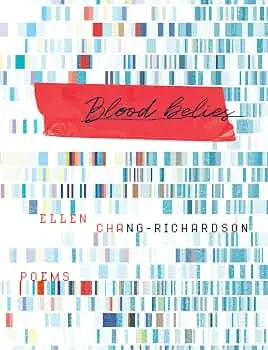
What is our relationship to the land on which we live? What is our relationship to our family? I’ve reflected a lot about these questions in my writing. Many writers have and will continue to explore them, but one book in particular that left me dwelling on how I’ve lived with these questions is Blood Belies (Wolsack and Wynn, 2024) from poet Ellen Chiang-Richardson (who was also my mentor for the 2025 TWUC BIPOC Writers Connect conference). Being a second-generation immigrant child, I’ve always been, in one form or another, acutely aware of the liminal space where the answer to the question “Where are you from?” resides. Chiang-Richardson brings their audience into that same liminal space, infusing their pieces with blank spaces which give their poems a sense of uneasy expansiveness. The piece “urban facts 2.0” combines the use of blank space with circular patterns to show Chiang-Richardson’s lived experience with white supremacy across the backdrop of anti-Asian racism in Canadian history, but seeing time set as a circle reminds me of the circularity of racism and white supremacy: They are patterns that have both happened before, and are happening again. This circular pattern is echoed in the piece “rorscharch” which chronicles Chiang-Richardson’s continuing experience with traumatic brain injury and its aftermath.
Chiang-Richardson also plays with textual form, using typographic structure and form to heighten the story she is telling.“resonate this” drew me into a beautiful two page concrete lyric construction of a tree, using imagery which linked me back to memories of elementary school, playing with friends who were mystified by the unfamiliar boxes of mango juice my father purchased on grocery runs to Chinatown, and reviled at the shrimp chips I gobbled down. Earlier in the piece the line, “immigrants leave sweat prints/on blank booklets of navy and gold” has the word ‘prints’ repeated on successive lines in a faded shade, evoking a memory of a time my own relationship with Canada was interrogated by two fellow travellers. I was clutching my navy and gold Canadian passport at the time. A talisman that did not protect me from their implicit lines of inquiry, delivered with silent smiles casting with shiny ivory veneer of genteel politeness.
In “storm surge”, Chiang-Richardson take us to their father’s oral history of escape from slavery to come to Canada, which stand in juxtaposition to other parts of the piece which to me evoked the isolation between the narrator and their family. The use of blank space here for me not just illustrates the omnipresence of white supremacy but also how isolated it can be to feel like you don’t really belong in the place where you live, even with your own family.
Blood Belies is a powerful illustration of the complicated relationships we have with the land on which we live, and with our own blood relations. But it is also a powerful illustration of how playing with form and blank space can itself show the complexity and nuance of marginalized experiences.
— Justin Ancheta (he/they) is a stuttering Filipino-Canadian passionate about tarot, science, and writing, living in Toronto (Treaty 13 territory). He is exploring his writing voice through lyric essays and creative non-fiction, drawing from his experience being bi+, ace, racialized and disabled. He is @rampancy on Instagram and @jancheta25 on Bluesky.
You can read Justin Ancheta’s essay "Because I wanted to fly higher than where my voice could take me" in Issue 308 (Summer 2026) Disability: The Revolution. Order the issue now:
Order Issue 308 (Summer 2026) Disability: The Revolution (Canadian Addresses)
Order Issue 308 (Summer 2026) Disability: The Revolution (International Addresses)