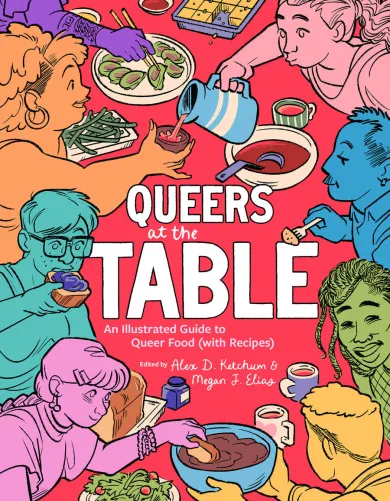
Born out of the 2024 Queer Food Conference at Boston University, Alex D. Ketchum and Megan J. Elias’s Queers at the Table gathers brief works of journalism, conference proceedings, cultural analyses, recipes, graphic art, and stories about queer food cultures. But this is not your typical conference book. Unlike, for example, David Halperin and Valerie Traub’s Gay Shame, Queers at the Table leans to a more accessible audience. While you’ll find no shortage of PhD holders and candidates in the author bios, these are not pieces you need a graduate degree to understand.
Bonnie J. Morris’s piece, “Festival Cuisine,” is the kind of story that surprises you with its ease — its premise so simple and yet so insightfully unique. Morris recounts her life documenting meal cultures at women-only entertainment festivals — “almost 40 years . . . eating hundreds of meals with lesbians from all over the world as I took notes.” Morris goes into the dietary restrictions of ethically minded people and the concessions festival staff have to make to please hundreds of them all at once. On the binary opposite end, “HIV/AIDS and Nourishing Well-Being: Sharing Recipes (and Jokes) to Feel Better” covers zine sharing as community care through the column Get Fat, Don’t Die in Diseased Pariah News. Authors Isabel Marie Barbosa, Elena Kalodner-Martin, and Jo Michael Rezes detail the lineage of the zine culture from the HIV/ AIDS epidemic to contemporary transgender healthcare information, including postsurgical recovery meals and foods which can improve embodiment. These pieces exemplify the deep living that sustains us in joy and tragedy, and the research needed to bring not just the meal but the story behind it to the potluck.
Diana Farin Molina’s essay, “Knead the Self, Cook the World: Audre Lorde’s ‘Uses of the Erotic’ as Cookbook,” is a refreshing take on Lorde’s ideas and the way we digest them — and I do mean digest, not some trite metaphor dressing up sterile comprehension. Molina frames Lorde’s work as a cookbook, as opposed to a tool kit — a term evocative of “The Master’s Tools Will Never Dismantle the Master’s House” — because “a cookbook is alchemical: it incorporates the intersecting personal and cultural experiences of the recipe writer...Every time a cook prepares a dish, they develop and recalibrate the recipe on the level of experience.” Molina homes in on Lorde’s kneading imagery and offers a potent reading of the nuance in Lorde’s wartime margarine rations. Like rations, the analysis is a morsel — less than you’d like, but powerful in its lack. Molina directs readers familiar with the essay to this aspect of Lorde’s writing that, perhaps ignored, warrants fuller consideration — the inherent sensuality of a shared meal or its preparation, “kneading the self with others.”
But this gets at my main frustration with this collection. So many of the early prose pieces end before they really get going — not unlike conference abstracts. Aino Pihlak’s piece, “A Moveable Feast: Twentieth-Century Trans Feminine Subcultural Get-Togethers,” doesn’t get to the food in any real substance until the last paragraph, and even then it merely gestures at regional cuisines like Boston clambakes. Pihlak mentions trans feminine subcultures but does not substantively describe what those subcultures are or what precisely makes food noteworthy within these groups or in their magazines. While I appreciate an amuse-bouche, at some point you have to wonder if you’re ever getting the main course.
I have no such complaints, however, for the comics. The comics bring to life so much of the theory in the prose. I especially want to highlight Rani Som’s “The Cart-Sisters” and Tara Madison Avery’s “Breaking Bread.” Som’s piece is a delightfully Sapphic heartbreak story with a travelling convoy of South Asian street-food vendors. This comic blends all things Queers at the Table is: intrigue rooted in care and collectivity, and a sense of duty to preserve ourselves and our ways. In “Breaking Bread,” Avery and colourist Mike Sullivan bring to life something so important: a kitchen-table polycule of queer elders. Paramours and metamours alike gather for a visiting member’s famous shokupan, and it’s this Japanese bread that shows both the labour and the ease that comes with being both long distance and poly. It is work, but it is loved, and it is honoured. And it is all so normal — as normal as the adult nonbinary child moving back home because of roommate drama.
The short prose does actually serve the book the deeper you go, particularly the book’s recipes section. The stories each cook offers give just enough to contextualize their confections — season them, if you will. You won’t be flipping pages as if quick scrolling an Epicurious page just to get to the recipe. Your mileage may vary trying to recreate them, though. You might find yourself confidently asserting to your partner that you can totally bake the Earl Grey Lavender Menace Layer Cake for Valentine’s Day, only for the cake to crumble out of the pan, for the icing to come out like a smoothie, and for the guy at the alt food store to tell you that edible essential oil is a scam, when you’re just trying to do your own job and follow the instructions. Or you may find yourself reusing the sauce from the Homemade Chico’s Tacos for other tomato sauce needs. Perhaps you might even buy leeks! I especially recommend Pri Aguilar’s Bisteck with Tallarín Verde — it’s worth splurging for the steak at least once, and you can reuse the tallarín anytime you make pasta.
Ketchum and Elias have cultivated a conference book that rewards the reader’s curiosity. Like so much of being queer, Ketchum and Elias invite the reader to explore possibility through desire in communal eating. One comic in this collection is a story about grieving a dead friend through the tea date they were planning. I hope that person feels held by the queers at this table.
— Jamie Kitts is a writer, editor, and PhD candidate at the University of New Brunswick.
Read this review and many others in Issue 309 (Autumn 2026). Order the issue now:
Order Issue 309 (Autumn 2026) Canadian Addresses
Order Issue 309 (Autumn 2026) International Addresses