Pleasure and Its Containment
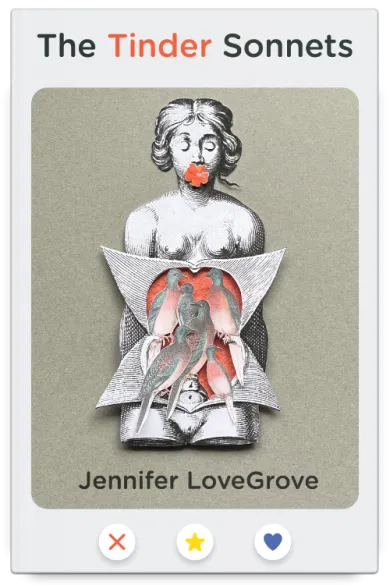
The Tinder Sonnets, Jennifer LoveGrove. Book*hug Press, 2026.
Even if you’ve been out of the dating scene for a while, you might have noticed that people don’t seem to be enjoying it much. Mainstream media are full of headlines like “Gen Z yearns for the pre-digital dating era — but don’t ask them out in person” (The Guardian, July 10, 2024) and “The Trouble with Wanting Men” (The New York Times, July 21, 2025). The apps are terrible, everybody’s into a bunch of weird new sex stuff or judging you for being into that same stuff, and no one knows how to have a conversation anymore. But! We can still write poetry about it!
Finding herself single and dating in mid-life, Jennifer LoveGrove has crafted a book-length meditation on encounter, vulnerability, and self-protection. Each poem in The Tinder Sonnets comprises a triptych of blank sonnets (fourteen unrhymed, metred lines). Here, LoveGrove uses the sonnet — a traditional form for love poetry — to express a fluid, uncertain context of sexual negotiation. The triptych format enables an evolution within each piece, which LoveGrove handles in a variety of ways across the length of the book. Some of the poems progressively mangle and dissolve their text, as in the piece titled “That time you made me a flow chart of our relationship,” where the initial question, “Did your father betray your mother? If / yes, press the elevator down button,” morphs into “Did your father betray you? If yes, press / did your father betray your mother?” and finally, in the third part, to “Did your fault betray your motif? If yes / price this drachma accordingly.”
Readers of LoveGrove’s earlier poetry collection, Beautiful Children with Pet Foxes (Book*hug Press, 2017), will recognize her penchant for personification of the animal, vegetable and mineral worlds as avatars of the emotional self. She dabbles in the arts of herbology and alchemy and draws deep from the dark heart of fairy tale. Several of the poems in The Tinder Sonnets incorporate botanical language, complete with Latin terminology (“Miscanthus sinensis” and “semen coicis” and “Citrus maxima”). Other poems invoke homespun folklore, such as the injunction to
Plough the field in a circle with twin brown
oxen. If the farmer’s also a twin,
crops will be safe from locusts, hail, disease,
and disasters.
These invocations speak to the natural magic that’s involved in making physical and emotional connections to another person and to the ritualized ways we approach that in a dating context. Any ritual to ensure safety implies the looming presence of danger. The lover spits in her mouth, shows her photographs of the buildings he’s architected, takes her to the Banksy exhibit, disappears for weeks at a time.
Midnight, after the concert, we fuck in
my kitchen. Morning, alone, my neighbour
tries to force his way in.
It isn’t just that the dates can be awkward, or the lovers both cold and demanding, it is the exhilaration and horror of seeking sexual pleasure in a world where women’s bodies are constantly under threat.
Supposed to say yes, say no, say nothing,
smile on demand, acquiesce and swallow
everything whole,
LoveGrove intones in the piece titled “Stibnite, house of antimony: dating as aversion therapy.” She continues with the devastating pronouncement, “Gag is both noun and verb. / Don’t worry. I’m not even a person.”
What does it take to make a woman a person? In Canada, women were legally declared “persons” in 1929, and yet it often still does not feel that way. If the masculine lover
. . . . . . . . . . . . . dreams of me in rain,
in his coastal hometown, does that mean
I’m a person?
Is personhood simply a matter of survival?
Survival is important to women,
but that alone is not enough. We can
do so much more than not die.
LoveGrove indicates in the notes that the sonnets are “playing with various Oulipean constraints.” The sonnet in its contemporary interpretation can be quite a loose form, encompassing anything that runs to about fourteen lines. There is no longer a requirement to adhere to any specific rhyme scheme, nor to stick with iambic pentameter, let alone to choose between Shakespearian and Petrarchan modes. There may or may not be a volta, a distinct point at which the sense of things takes a turn and perspective broadens. Modern dating, by analogy, would seem to be free of the formal restrictions of yesteryear — the chaperones, the expectation that the man will do the asking (and the paying), the third-date/third-base progression, the move towards monogamy. However, absent these socially acknowledged rules and regulations, today’s dater finds herself entangled in a baffling morass of unstated limitations and demands, often of a seemingly Oulipean character. What does this particular partner think we are doing? What norms are in his head, what expectation is she holding for you, what are their unarticulated requirements? How are we to walk together on a road so variously signposted, with so many intersections and alleyways?
You’ll not find the answers in The Tinder Sonnets, but you may find a kind of connection that isn’t on the apps — the meeting of a keen, questioning mind making a path for herself through the thorny wilds of love.
— Dawn Macdonald won the 2025 Canadian First Book Prize for her poetry collection Northerny.
Read this review and many others in Issue 309 (Autumn 2026). Order the issue now:
Order Issue 309 (Autumn 2026) Canadian Addresses
Order Issue 309 (Autumn 2026) International Addresses