“My god, it was glorious”
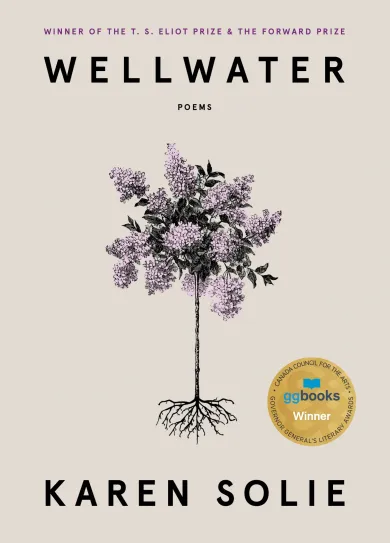
Wellwater, Karen Solie. House of Anansi Press, 2025.
Karen Solie’s technical brilliance, deadpan humour, and astute insight into the human condition have garnered critical accolades as well as a wide international audience. Wellwater amply demonstrates all these gifts and more. The directness of speech and heightened vulnerability that characterize this book convey an open-handed generosity to her readers, who are challenged, respected, and trusted in equal portions.
“Left to our use are the fixtures and appliances / repented of by the homeowners.” The book’s opening poem, “Basement Suite,” immediately locates the speaker — hapless renter of said grim apartment. “In the basement one is closer to God because / closer to consequence.” This comic reversal, where down is up, precludes mere self-pity. But the line also introduces a thematic core to the book, that of the consequences of human action. Wellwater investigates everything from the rueful blunders of our personal lives to the global societal errors threatening the planet’s ecosystems.
“I didn’t know what I had.” The opening line of the title poem, “Wellwater,” encapsulates this moment in the climate crisis. The first-person singular claims personal responsibility, an important and effective strategy both rhetorically and ethically. The poem’s teenage speaker idles the water truck as it fills at the well, blithely wasting gas so the battery won’t run down as she listens to the radio: “a mistake I’d made and lived to regret, / which is the only way I ever learn anything.” The mistake is presented ironically as running down the battery, not wasting fossil fuel. The poem’s conclusion is devastating: “The water then, you could still drink it.”
Perhaps my favourite poem in the book is “That Which Is Learned in Youth Is Always Most Familiar.” The context here is immediately set:
Returning from a walk through the fields
in the dirty realism of early spring,
he ran up beside me and said Auntie,
do you know what?
The poem then portrays the speaker’s unflattering assumptions about kids, which are knocked flat in the child’s statement which follows, a profound philosophical understanding of the world. The poem ends:
He’s five. And not even I,
who would rather be right than happy,
could argue.
“Red Spring” examines the specifics of contemporary industrialized farming. Lists of trademarked pesticides and herbicides vie with lists of weeds, which
. . . jump up unbidden, each year a little smarter
and more vigorous, with the high-pitched optimism
of adaptation, sinking their anchors into the deep
and banging their empty cups on the table.
The speaker’s “I” isn’t introduced until halfway through the poem; she is a vulnerable worker/soldier in this battle: “I was given no mask and threw up for six hours.” The poem, as infused with hope as it is with anger, can be read in part as a tribute to the versatility and resistance of nature. Though the speaker asserts twice that she “can’t make this beautiful,” in the end, she must admit that “when the wind trails its fingers through the durum / it is, [. . .] It’s beautiful.”
The anthropomorphism Solie uses in “Red Spring” and in many other places in the book is comedic, and the wit is highly pleasurable: streetlights stare, a mall has its hands in its pockets, trees sleep on their feet, a vine has everything it owns strapped to its body. Granting personhood to the non-human world does more than amuse, however; it implicitly puts into question our exploitation of nature as it acknowledges that all that is natural, as well as the human made, can be seen as part of a continuum of sentience and perhaps even consciousness.
In “The Grasslands,” Solie continues this strategy.
In winter you might hear
an elderly grass blade
shrugging off a shawl of frost,
under the crust the snow’s muscles twitching,
a vole clearing her throat.
This poem returns to the question of beauty and its purpose in the world: “Is this beauty, all this grass?” There is no pathetic fallacy here; the park is inhospitable, even hostile. Nature in this place is not benign, not fond of humans. This lack of hospitality is contrasted with the description of the abundance of “the kingdom of grass” that follows. The core of the book’s environmentalism is displayed in these lines: “They belong to themselves as you belong to yourself, / more difficult to restore than to destroy.” We need the rest of creation, whether or not it needs us.
“Holiday at the Wave Pool” is a compelling example of Solie’s control of voice, her ability to position the speaker effectively. The syntax in this poem starts off wryly formal, using passive voice and avoiding pronouns. About a third of the way through, the general you enters with “your heavy coat.” Then an equally wry we enters: “we of the just looking.” At the ending the we becomes very personal and highly defined: a family whose mother and newborn sibling are still in hospital and whose dad takes them every night to the mall for dinner at McDonald’s. “And my god, it was glorious.”
This is a sentiment I can only echo in my appreciation of this spectacular book.
— Rhea Tregebov is the author of eight collections of poetry, two novels, and five children’s picture books; she is Associate Professor Emerita of the School of Creative Writing at UBC.
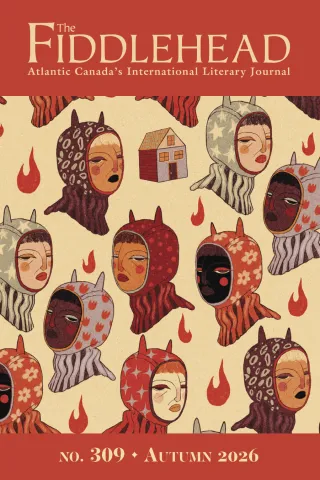
Read this review and many others in Issue 309 (Autumn 2026). Order the issue now:
Order Issue 309 (Autumn 2026) Canadian Addresses
Order Issue 309 (Autumn 2026) International Addresses