Honk for Dissecting the Colonial Archive!
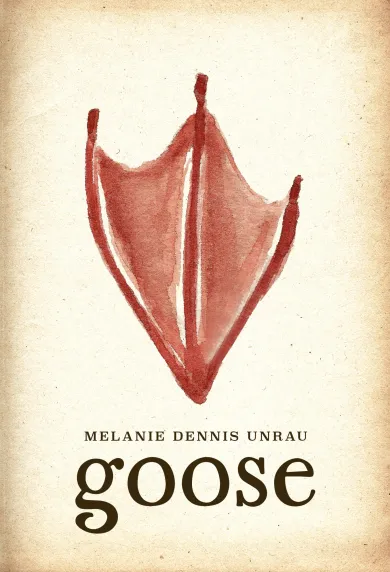
Goose, Melanie Dennis Unrau. Assembly Press, 2025.
The first page of Melanie Dennis Unrau’s latest book of poetry is scattered with the words “geese” and “goose.” The next sheet litters the same words — along with “ducks” added to the mix — across white space, and the adjacent page features drawings of birds criss-crossing in their flight formations. The book, titled Goose, seems to announce itself transparently. There are geese, spelled out. There are drawings of geese. But what is this book about?
Although it may appear at first glance to be a project of poetic whimsy, Unrau’s text is a cutting rejoinder to one man and his work that responds to the history of the entire Albertan oil sands industry. The man in question is Sidney Clarke Ells (1878–1971), a Canadian Department of Mines expert who, as Unrau tells us, “liked to be called ‘the father of the tar sands.’” From 1913 to 1945, Ells surveyed land along the Athabasca River, oversaw mining operations, and experimented with bitumen extraction; his work was “foundational to the industry.” Ells was also an amateur writer and artist. Unrau excavates Northland Trails — a collection of Ells’s poems, short stories, and essays, illustrated by the author — as a found text for erasure and creative concoction. The result is poetry that sings and honks and trips and stumbles across the pages, evoking pathos for Ells and delivering a compelling study of the language that established and continues to inform the colonial project of oil production in Canada.
Unrau speaks of her relationship to Ells and her poetic process in the book’s afterword, where she describes how she painstakingly traced words and drawings from Northland Trails onto paper, working “with the constraint of tracing these elements exactly where they appear on Ells’s pages, . . . letting the markings overlap.” Like other found poetry of archival material (M. NourbeSe Philip’s Zong!, which Unrau also names in her afterword, immediately comes to mind), this text mines source material in a way that is as much about process as product. After learning that Unrau traced Ells’s work, I flipped back to the book’s first pages of poetry, realizing that the slightly off typography — a font with a wobble — is the result of typeset text that has been inked over by hand. The wobble reveals the mark of Unrau’s own body in Ells’s words and drawings, bringing the two authors into an unlikely intimacy. She recalls trying to get close to him in other ways: how she “took a carbon-intensive trip to retrace the route he and the trackers travelled along the Athabasca River from Fort McMurray to Athabasca” and visited Ells grave at the Beechwood Cemetery in Ottawa. Although she “disliked Ells” and “sensed that he would dislike [her],” these trips and the process of writing Goose brought her close to Ells’s body — she walked and scrambled where he walked and scrambled, she drew over the lines his hand drew, she visited his body’s remains — highlighting the material connection of the two writers across time and the indelible imprints they leave on the earth.
The product of Unrau’s experiment is just as intriguing as its process. What glimpses of truth can only be unveiled by intentionally strange procedures and pairings? In the text’s first section, “The Goose,” words flit across the page, mirroring the flight paths of the geese that Unrau redraws by tracing. As the erasure poems grow in complexity and vocabulary, a chant or refrain sometimes emerges, such as through the prepositional phrases scattered across one page: “through the mists against the rising sun,” “from lowering sky,” “from the blue,” “through snow and sleet / and darkness,” “Above the foaming flood and nameless lake.” Whereas some pages flaunt their playfulness, others owe their poetic beauty to Unrau’s arrangement. In the second section of the book, “the tracking line(s),” Unrau focuses on the historical archive around Ells’s 1913 poem “The Athabaska Trail” and the journey he took with hired First Nations and Métis trackers up the Athabasca River. She uses a letter addressed to “My dear Corporal,” dated November 4, 1913, to create two erasure poems. The first traces a series of optimistic words and phrases from the letter (“ample,” “good,” “happy,” “fitting,” “strong,” and “young ‘Bacon-face’ and his associates / great / on the tracking line altogether worthy”), while the second begins “I was wrong,” and continues with hints of trouble: “Oppressive,” “obnoxious,” “astray,” “quite appalling,” and “might find a watery grave, or come to some other / fitting end.” Although the content of the original letter isn’t wholly clear, Unrau’s erasure underlines both the triumph and treachery of Ells’s journey and of his mining projects more generally.
Unrau satirizes Ells, not missing the opportunity to gently mock him. One page, for example, is filled entirely with iterations of Ells’s handwritten signature. Drawing attention to the individualism complicit with a colonial extractivist mindset, the page also recalls a young person practicing their signature, looking to hone their mark, to find their identity. In “My Symphony,” Unrau responds to Ells’s poem of the same name, erasing all but the letters h, o, n, and k. The resulting text is a version of Ells that tries hard to “honk,” with much trial and error, as if he is struggling to become a goose. Poems like these may draw laughter and be quick to sound out, but other parts of the book, with overlapping text and phrases meant to be read diagonally, frustrate linearity and force the reader to slow down or bring the book close to their eyes. Unrau’s experimental poetics deconstructs not only writerly process but also our habitual reading practices.
Calling Melanie Dennis Unrau’s Goose “fun” might be an oversimplification of the labour put into this book of experimental poetry, but I really did have fun reading it. And that’s how this text strikes a chord: it is both rigorous and intuitive in its methodology, serious criticism that doesn’t lose sight of life’s inherent humour. There is levity in Unrau’s pages as much as there is critique and, for many of us, something to learn about oil-sands history and the construction of our present-day realities.
— Rebecca Geleyn is a writer and English professor in Moh’kinsstis (Calgary, AB).
Read this review and many others in Issue 309 (Autumn 2026). Order the issue now:
Order Issue 309 (Autumn 2026) Canadian Addresses
Order Issue 309 (Autumn 2026) International Addresses